
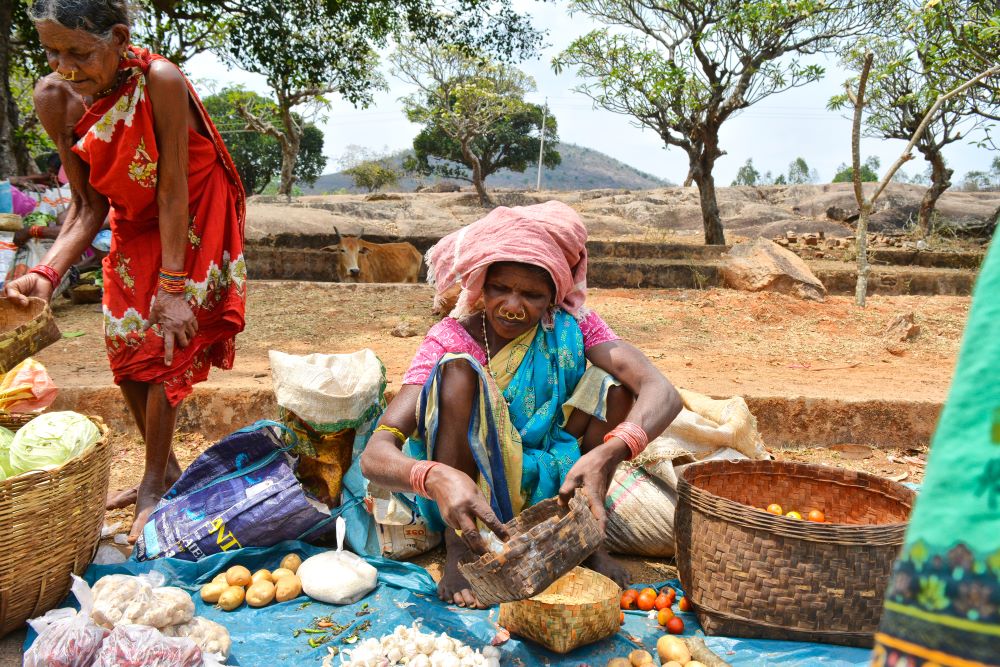
Rising across the tribal heartland of southern Odisha, the Niyamgiri Hills are one of the state’s most culturally significant and visually striking highland landscapes.
Spread across parts of Rayagada and Kalahandi districts, Niyamgiri is closely associated with the Dongria Kondh, an indigenous community whose cultural identity, traditional livelihoods and spiritual beliefs are deeply connected with these forested hills.
For travellers interested in tribal Odisha, Niyamgiri offers much more than scenic landscapes.
The region provides an opportunity to understand the relationship between indigenous culture, forests, agriculture, weekly markets and the hills themselves.
One of the most practical ways for travellers to experience this wider cultural landscape is through Chatikona Tribal Market, a weekly market near the Niyamgiri region that is commonly visited on Wednesday as part of southern Odisha tribal itineraries.
However, Niyamgiri should not be approached like an ordinary sightseeing destination.
Remote villages are people’s homes, the hills have deep cultural significance, and photography and village visits require sensitivity.
This Niyamgiri Hills travel guide explains the Dongria Kondh cultural connection, Chatikona market, how to reach the region, where to stay and how to plan a responsible journey.
Where Are the Niyamgiri Hills?
The Niyamgiri Hills are located across parts of Rayagada and Kalahandi districts in southern Odisha.
The hill range forms part of the Eastern Ghats and contains forested slopes, streams, agricultural landscapes and remote settlements.
For travellers following the main southern Odisha tribal circuit, Rayagada is one of the most practical gateways to the region.
Chatikona can then be incorporated before continuing towards Jeypore and Koraput.
A typical cultural route is:
Rayagada → Chatikona → Niyamgiri Region → Jeypore
This makes Niyamgiri relatively easy to combine with other important tribal destinations without treating it as an isolated excursion.
Explore: Rayagada Tribal Tourism →
Why Are the Niyamgiri Hills Important?
Niyamgiri is important for both ecological and cultural reasons.
The hills support forests, streams and agricultural landscapes while also forming the traditional homeland of indigenous communities.
For the Dongria Kondh, Niyamgiri is much more than a geographical location.
The hills are deeply connected with cultural identity, traditional knowledge, livelihoods and spiritual beliefs.
This is one of the most important things for travellers to understand before visiting.
Niyamgiri should not simply be seen as a scenic backdrop for photographs.
It is a living cultural landscape.
Who Are the Dongria Kondh?
The Dongria Kondh are an indigenous community associated closely with the Niyamgiri Hills.
They are officially recognized among Odisha’s Particularly Vulnerable Tribal Groups (PVTGs).
Their traditional way of life has developed in close relationship with the hill environment.
Agriculture and forest resources have historically played important roles in local livelihoods, while the landscape itself holds deep cultural and spiritual significance.
Dongria Kondh identity is also expressed through language, clothing, jewellery, agricultural knowledge and community traditions.
For visitors, understanding this relationship between people and landscape is far more meaningful than simply trying to photograph distinctive clothing.
Discover: Dongria Kondh Tribe – Culture, Niyamgiri & Traditions →
Dongria Kondh Culture & the Niyamgiri Landscape
One of the defining characteristics of Dongria Kondh culture is the close relationship between community life and the Niyamgiri environment.
The hills influence agriculture, settlement patterns, food systems and cultural traditions.
Fruit cultivation and other forms of hill agriculture are important parts of the wider regional economy.
This relationship becomes particularly visible at weekly markets, where produce from surrounding villages is brought for sale and exchange.
For culturally curious travellers, this provides a useful way to understand Niyamgiri.
Instead of seeing the hills, villages and markets as separate attractions, consider them as interconnected parts of one cultural landscape:
Hills → Villages → Agriculture → Produce → Weekly Market
This perspective makes a journey through Niyamgiri much more meaningful.
Chatikona Tribal Market – Gateway to the Niyamgiri Cultural Region
For most travellers, Chatikona Tribal Market is one of the most accessible ways to experience the wider cultural landscape associated with Niyamgiri.
The weekly market is traditionally incorporated into tribal itineraries on Wednesday.
People from villages in the surrounding region gather at Chatikona to trade agricultural produce, forest products and everyday goods.
The market is particularly known among travellers because of its association with people from the Dongria Kondh cultural region.
However, it is important to understand that Chatikona is not a cultural performance arranged for visitors.
It is a working local marketplace.
The best way to experience it is to observe respectfully, understand what is being traded and appreciate the relationship between the market and the surrounding Niyamgiri landscape.
Explore: Chatikona Tribal Market →
What Can You See at Chatikona Market?
The exact market scene varies according to season and local conditions.
Visitors may encounter agricultural produce, forest products, household goods and other items used or traded by surrounding rural communities.
But the value of Chatikona is not based on a checklist of products.
Observe how the market functions.
Look at the different types of produce.
Notice how people arrive from surrounding villages.
See how agriculture in the hill region connects with trade in the market.
Listen to the sounds and movement of a working rural haat.
These details often reveal much more about everyday life than a collection of posed photographs.
Which Day Is Chatikona Tribal Market?
Chatikona is traditionally visited on Wednesday in many Odisha tribal itineraries.
This makes it especially useful because it can form the first part of a three-market route:
Wednesday – Chatikona
Thursday – Onukadelli
Friday – Kunduli
A well-planned itinerary can therefore begin in Rayagada, visit Chatikona and Niyamgiri, continue to Jeypore and then experience two additional markets over the following two days.
Market schedules and local circumstances can change, so always reconfirm current arrangements before travel.
Read: Onukadelli, Chatikona & Kunduli – How to Plan Odisha’s 3-Market Tribal Circuit →
How to Visit the Niyamgiri Hills
This requires more care than visiting an ordinary tourist destination.
The Niyamgiri Hills contain remote settlements and culturally sensitive areas.
Travellers should not simply search for village names online and independently drive into settlements looking for people to photograph.
Access conditions and local circumstances may vary.
If your itinerary involves village areas beyond the established travel circuit, current local access conditions should be checked before travel.
For most first-time visitors, a responsible introduction can focus on:
Rayagada → Chatikona Market → Niyamgiri landscapes → onward journey to Jeypore
This provides cultural context without assuming that every remote settlement should be open to tourism.
Can Tourists Visit Dongria Kondh Villages?
The answer depends on the specific location and current local conditions.
It is better not to think of “Dongria Kondh villages” as a standard sightseeing product.
Some settlements may be remote, culturally sensitive or subject to changing access considerations.
Travellers should use appropriate local guidance and respect any restrictions or community preferences.
Even where physical access is possible, that does not automatically mean visitors should enter private areas or photograph residents.
Access and consent are different things.
If a village visit is appropriate, keep the experience respectful and low-impact.
Read: How to Visit Tribal Villages in Odisha →
Do You Need Permission to Visit Niyamgiri?
Requirements and local procedures can change.
For that reason, avoid relying on old blogs or assuming that a previous traveller’s experience automatically applies to your trip.
Before travelling into remote or sensitive areas, check the current situation through appropriate local channels or knowledgeable guides.
For a standard journey through Rayagada, Chatikona and established public routes, arrangements may differ from those required for attempting to enter remote village areas.
The itinerary should therefore be planned according to the exact places you intend to visit.
Photography in Niyamgiri & Chatikona
Niyamgiri can be extraordinarily rewarding for travel photography, but it also demands cultural sensitivity.
Photograph the landscape
The hills, agricultural fields, forested slopes and roads can tell a powerful story without intruding on anyone’s privacy.
Ask before taking portraits
Never assume that someone wants to be photographed because they are wearing distinctive traditional clothing.
Respect the market
Do not block paths or interrupt trading at Chatikona to create a photograph.
Avoid staged interactions
Do not pressure people to pose or offer money simply to manufacture a photograph.
Photograph cultural context
Market produce, agricultural landscapes, textiles, hands at work where appropriate and wider environmental scenes can create meaningful images.
Accept “no”
If someone declines a photograph, move on immediately.
How to Reach Niyamgiri & Chatikona
For most travellers following a tribal Odisha itinerary, Rayagada is the practical base for visiting Chatikona and experiencing the wider Niyamgiri landscape.
A common route is:
Bhubaneswar → Rayagada → Chatikona → Jeypore
The exact transfer plan depends on where your journey begins.
Longer tribal itineraries may approach Rayagada after travelling through Kandhamal, while shorter market-focused tours may travel more directly to Rayagada.
After Chatikona, continuing towards Jeypore is particularly practical because it positions you for Thursday’s Onukadelli market.
Read: How to Reach Tribal Odisha →
Where to Stay for a Niyamgiri & Chatikona Visit
For most travellers, Rayagada is the most practical overnight base before visiting Chatikona.
A well-planned sequence is:
Tuesday Night
Stay in Rayagada.
Wednesday Morning
Travel from Rayagada to Chatikona.
Wednesday Afternoon
Continue through the wider Niyamgiri landscape.
Wednesday Evening
Proceed to Jeypore.
This prevents unnecessary backtracking and positions you perfectly for the next day’s Onukadelli market.
Read: Where to Stay in Tribal Odisha →
How to Combine Niyamgiri with Onukadelli & Kunduli
This is the route I recommend for most first-time cultural travellers.
Wednesday – Niyamgiri & Chatikona
Rayagada → Chatikona → Niyamgiri → Jeypore
Visit Chatikona market and travel through the Niyamgiri cultural landscape.
Overnight: Jeypore
Thursday – Onukadelli
Jeypore → Onukadelli → Bonda Cultural Region → Gadaba Village Region → Jeypore
Visit Onukadelli and explore appropriate surrounding cultural areas.
Overnight: Jeypore
Friday – Kunduli & Koraput
Jeypore → Kunduli → Koraput
Visit Kunduli market and explore the wider Koraput region.
This three-day sequence is one of the most effective ways to combine different cultural regions without unnecessary backtracking.
Explore: Odisha Tribal Market Tour – 5 Nights / 6 Days →
Suggested 5 Nights / 6 Days Niyamgiri & Tribal Market Itinerary
Travellers wanting to make Niyamgiri part of a broader cultural journey can use the following route.
Day 1 – Bhubaneswar → Rayagada
Travel from Bhubaneswar to Rayagada.
Overnight: Rayagada
Day 2 – Chatikona & Niyamgiri
Visit Chatikona Tribal Market and experience the wider Niyamgiri landscape before continuing to Jeypore.
Overnight: Jeypore
Day 3 – Onukadelli
Visit Onukadelli Tribal Market and explore the surrounding Bonda/Gadaba cultural landscape according to current conditions.
Overnight: Jeypore
Day 4 – Kunduli & Koraput
Visit Kunduli market before exploring Koraput.
Overnight: Jeypore
Day 5 – Nandapur & Village Landscapes
Explore selected Gadaba and Paraja cultural regions around Nandapur and the wider Koraput countryside.
Overnight: Jeypore
Day 6 – Departure
Continue towards Visakhapatnam or Bhubaneswar, depending on your onward journey.
Explore the Complete Odisha Tribal Market Tour →
Best Time to Visit Niyamgiri Hills
The cooler months are generally more comfortable for travelling through southern Odisha’s hill regions.
However, if your main objective is to combine Niyamgiri with Chatikona market, the day of the week becomes extremely important.
Build your itinerary around Wednesday first.
Then, if possible, continue to:
Onukadelli – Thursday
and
Kunduli – Friday
This is more important for a market-focused cultural itinerary than simply selecting dates based on weather.
Seasonal weather, road conditions and current local access should also be considered.
Read: Best Time for Odisha Tribal Tourism →
What Else Can You Visit Near Niyamgiri?
Niyamgiri is best incorporated into a wider southern Odisha journey rather than treated as an isolated destination.
Rayagada
Use Rayagada as your practical gateway and overnight base before Chatikona.
Explore: Rayagada Tribal Tourism →
Jeypore
Continue to Jeypore after Chatikona and use it as your base for Onukadelli and surrounding cultural regions.
Onukadelli
Visit on Thursday when your itinerary allows.
Explore: Onukadelli Tribal Market →
Koraput
Continue towards Koraput after Kunduli to explore the wider cultural landscape.
Explore: Koraput Tribal Tourism →
Nandapur
Add a village-focused day around Nandapur and selected Gadaba/Paraja cultural regions if you have additional time.
Niyamgiri or Bonda Hills – Which Should You Visit?
Both regions offer very different experiences.
Niyamgiri
Best suited to travellers interested in:
- Dongria Kondh cultural context
- Hill landscapes
- Chatikona market
- Rayagada
- Agriculture and forest landscapes
Bonda Cultural Region
Best suited to travellers interested in:
- Bonda culture
- Onukadelli market
- Malkangiri cultural landscapes
- Jeypore-based excursions
If you have sufficient time, you do not need to choose between them.
A carefully planned itinerary can include Niyamgiri/Chatikona on Wednesday and Onukadelli on Thursday, followed by Kunduli on Friday.
Read: Bonda Hills Travel Guide →
Chatikona or Onukadelli – Which Market Is Better?
There is no meaningful “better” market because they represent different regions and cultural contexts.
Chatikona
Closely connected with the Niyamgiri landscape and Dongria Kondh cultural region.
Onukadelli
Associated with communities from the wider Bonda, Gadaba and Didayi cultural regions.
If you are interested in tribal culture, visiting both provides a much more complete understanding of southern Odisha than selecting only one.
Responsible Travel in the Niyamgiri Hills
Niyamgiri requires particularly thoughtful travel because it is simultaneously an ecological landscape, a cultural homeland and a place where people live and work.
Do not treat remote villages as attractions.
Do not photograph people without permission.
Do not enter houses or private spaces without invitation.
Do not distribute sweets or money to children for photographs.
Do not pressure anyone to pose.
Avoid language that describes indigenous communities as “primitive” or treats cultural differences as curiosities.
Listen to local guidance.
Respect restrictions.
Purchase local produce or genuine crafts appropriately when opportunities arise.
Most importantly, understand that the Niyamgiri Hills are a homeland first and a travel destination second.
Read: Responsible Tribal Tourism in Odisha →
Plan Your Niyamgiri Hills & Chatikona Journey
The Niyamgiri Hills offer one of the most meaningful cultural landscapes in southern Odisha for travellers interested in the relationship between indigenous communities, agriculture, forests and traditional markets.
For first-time visitors, the most practical route is usually to stay in Rayagada, visit Chatikona Tribal Market, experience the wider Niyamgiri landscape and then continue towards Jeypore.
From there, the journey can naturally extend to Onukadelli, Kunduli, Koraput, Nandapur and selected village regions.
At Odisha Tribal Trails, we arrange private and customizable journeys through these regions, planned around weekly market days, appropriate local access and responsible cultural travel.
Explore: Odisha Tribal Market Tour →
Explore: Odisha Tribal Tour Packages →
Frequently Asked Questions
Where are the Niyamgiri Hills?
The Niyamgiri Hills extend across parts of Rayagada and Kalahandi districts in Odisha.
Which tribe is associated with Niyamgiri?
The Dongria Kondh are closely associated with the Niyamgiri Hills and have deep cultural and spiritual connections with the landscape.
What is Chatikona Tribal Market?
Chatikona is a weekly market near the Niyamgiri region where people from surrounding villages gather to trade agricultural produce, forest products and everyday goods.
Which day is Chatikona market?
Chatikona is traditionally included in many tribal itineraries on Wednesday. The current local schedule should be reconfirmed before travel.
Where should I stay to visit Chatikona?
Rayagada is one of the most practical bases before visiting Chatikona.
Can tourists visit Dongria Kondh villages?
Access depends on the specific location and current local circumstances. Travellers should use appropriate local guidance and should never assume that remote settlements are automatically open to tourism.
Do I need permission to visit Niyamgiri?
Requirements can vary according to the exact places being visited. Current access conditions should be checked before travelling into remote or sensitive areas.
Can I photograph Dongria Kondh people?
Ask the individual before taking a close photograph. Access to a public market or region does not automatically constitute permission to photograph people.
Can I combine Niyamgiri with Onukadelli?
Yes. A particularly useful itinerary visits Chatikona/Niyamgiri on Wednesday, Onukadelli on Thursday and Kunduli on Friday.
How many days should I allow?
Around 5–6 days works well if you want to combine Niyamgiri and Chatikona with Onukadelli, Kunduli, Koraput and selected village experiences.