
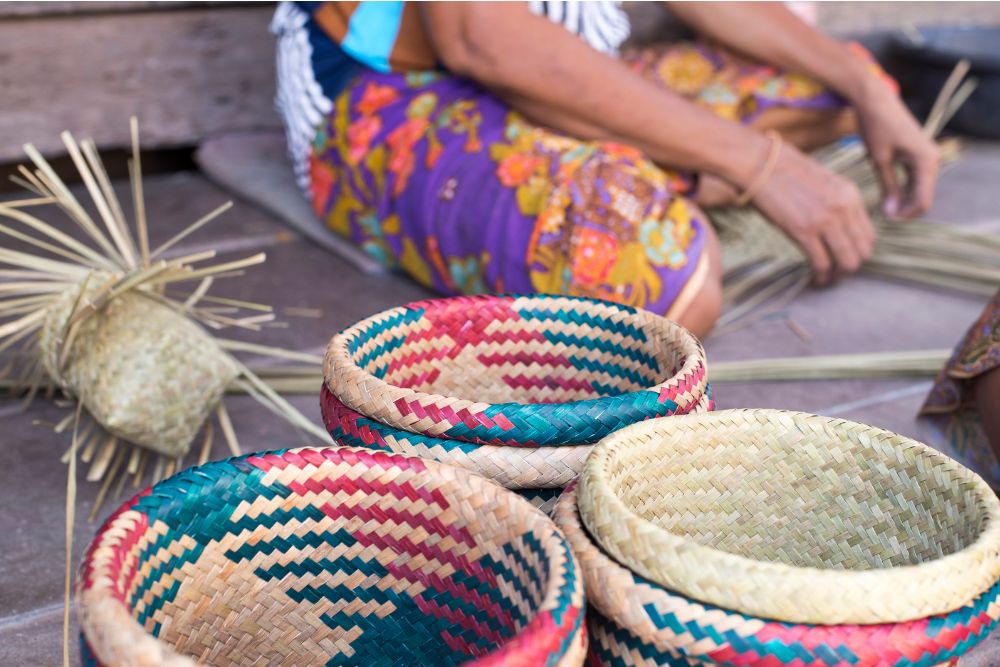
The tribal handicrafts of Odisha reflect generations of artistic knowledge, cultural identity and skilled craftsmanship. Across the hills and valleys of Koraput, Rayagada, Malkangiri and other parts of Odisha, artisans create textiles, ornaments, baskets, metal objects and traditional artwork that connect everyday life with community heritage.
From the naturally dyed Kotpad handloom textiles of southern Odisha to the distinctive Kapdaganda shawls of the Dongria Kondh, each craft tells a different story. Bamboo and cane weaving, traditional jewellery, Saora paintings and Dhokra metalwork further demonstrate the diversity of Odisha’s indigenous and regional artistic traditions.
These crafts are more than souvenirs. Some are everyday household objects, while others have ceremonial, social or cultural significance. Their designs, materials and techniques may reflect the landscapes, beliefs and artistic preferences of the communities that create them.
For travellers exploring tribal Odisha, learning about local handicrafts offers a meaningful opportunity to understand the region beyond its scenic landscapes and weekly markets.
In this guide, discover the most notable tribal handicrafts of Odisha, their cultural importance, the regions associated with them and how to support local artisans responsibly.
Why Are Tribal Handicrafts Important in Odisha?
Handicrafts play different roles in the lives of Odisha’s indigenous and artisan communities.
Some objects are created for practical use, such as baskets, mats and household containers. Others are made for personal adornment, community celebrations, cultural expression or sale.
Traditional craft knowledge can include understanding local materials, preparing natural dyes, weaving patterns, shaping metal and creating designs with cultural meaning.
For many artisans, craftsmanship is also an important source of livelihood.
However, Odisha’s indigenous communities are diverse, and their artistic traditions should not be treated as a single uniform style.
A textile woven in the Kotpad region differs significantly from a Dongria Kondh embroidered shawl. Similarly, Saora painting traditions are distinct from Dhokra metal casting.
Understanding these differences helps visitors appreciate the individuality of each craft and the people who make it.
Explore: Tribal Culture of Odisha
1. Kotpad Handloom Textiles – Natural-Dyed Weaving of Southern Odisha
Among the most distinctive traditional textiles of southern Odisha are Kotpad handloom fabrics.
Kotpad is a weaving centre in Koraput district, particularly associated with the skilled weavers of the Mirgan community.
These textiles are known for their earthy colours, geometric patterns and natural dyeing techniques.
What Makes Kotpad Textiles Special?
A defining characteristic of traditional Kotpad weaving is the use of natural dyes, especially colours derived from the roots of the aal tree, commonly identified as Morinda citrifolia.
The dyeing process requires considerable skill and preparation.
The resulting fabrics often feature deep reddish-brown, maroon, black and off-white tones.
Traditional motifs may include geometric forms and designs inspired by the surrounding cultural environment.
Products Made from Kotpad Fabric
Depending on the artisan and weaving unit, visitors may find:
- Traditional sarees and shawls.
- Dupattas and stoles.
- Dress materials.
- Contemporary garments.
- Decorative textiles and accessories.
Kotpad weaving is an example of how traditional techniques continue to find new applications.
Where to Explore Kotpad Weaving
Kotpad town and its surrounding weaving communities in Koraput district are the most relevant places to learn about this craft.
Travellers interested in visiting a weaving workshop should arrange the visit in advance and respect artisans’ working schedules.
Explore: Koraput Tribal Tourism
2. Dongria Kondh Kapdaganda Shawls – Embroidery with Cultural Meaning
The Dongria Kondh, an indigenous community associated with the Niyamgiri Hills, have a distinctive textile tradition known as Kapdaganda.
Kapdaganda is a traditional embroidered shawl associated with Dongria Kondh cultural identity.
Its designs often feature geometric patterns that hold significance within the community.
The embroidery is not simply a decorative addition. The shawls are part of a broader cultural tradition connected with identity, relationships and community life.
Traditional Designs and Colours
Kapdaganda shawls are recognizable for their geometric embroidery on a cloth base.
Different motifs and arrangements can carry cultural associations.
Travellers should avoid assigning a fixed symbolic meaning to every pattern without guidance from knowledgeable community members or reliable cultural documentation.
Why Kapdaganda Matters
The craft demonstrates the importance of textile knowledge within Dongria Kondh cultural heritage.
Kapdaganda has also received Geographical Indication recognition, highlighting its distinct regional and community association.
Where to Learn About Kapdaganda
The wider Niyamgiri region of Rayagada is associated with Dongria Kondh communities.
However, access to villages and opportunities to purchase genuine Kapdaganda textiles depend on local circumstances and appropriate arrangements.
Visitors should not assume that every Dongria Kondh settlement is open to tourism.
Read: Dongria Kondh Tribe of Odisha
Read: Niyamgiri Hills Travel Guide
3. Traditional Tribal Jewellery of Odisha
Traditional jewellery is an important form of personal adornment and cultural expression among several indigenous communities in Odisha.
Ornaments may include necklaces, earrings, bangles, hair accessories and other decorative pieces.
Materials can vary by community, locality and period.
They may include metal, beads, glass, thread and other available materials.
Jewellery of the Bonda Community
The Bonda community of Malkangiri is particularly well known for distinctive forms of personal adornment.
Traditional necklaces, beadwork and metal ornaments are recognizable elements of Bonda cultural dress.
However, these ornaments are not simply tourist accessories.
They are part of the personal and cultural identity of the people who wear them.
Visitors should never ask someone to remove jewellery for a photograph or assume that personal ornaments are available for sale.
Jewellery in Other Indigenous Communities
Different communities in Koraput, Rayagada and other regions have their own styles of ornaments and decorative traditions.
Some contemporary artisans also create jewellery inspired by regional designs for wider markets.
Such products should be described accurately rather than automatically presented as ceremonial or historically authentic pieces.
Buying Traditional Jewellery
If you wish to purchase jewellery, choose products made specifically for sale by artisans or authorized sellers.
Ask about the materials, maker and origin.
Read: Bonda Tribe of Odisha
4. Bamboo and Cane Handicrafts – Practical Skills and Local Materials
Bamboo and cane crafts are found in many parts of Odisha, including the southern districts.
These materials are used to make practical household objects and decorative products.
Traditional basket weaving demonstrates a close relationship between material knowledge, hand skills and everyday needs.
Common Bamboo and Cane Products
Artisans may create:
- Storage baskets.
- Agricultural carrying baskets.
- Mats and trays.
- Household containers.
- Decorative products.
- Small utility items.
The exact products and weaving techniques vary by region and artisan community.
How Bamboo Crafts Are Made
Depending on the product, bamboo is cut, split, prepared and woven into the required shape.
Skilled artisans understand the flexibility and strength of different materials.
A simple-looking basket may require considerable precision and experience.
Where to Find Bamboo Crafts
Craft products may be available through artisan workshops, local markets, cooperative outlets and handicraft exhibitions.
Koraput, Rayagada, Malkangiri and other Odisha districts have recognized bamboo and cane craft activity.
For travellers, buying a useful handmade basket directly from a producer can be a practical way to support local craftsmanship.
5. Saora Painting – Traditional Art and Cultural Expression
Saora painting, also written Soura or Sora painting, is one of Odisha’s distinctive indigenous art traditions.
It is associated with Saora communities, particularly in parts of southern Odisha.
Traditional Saora wall paintings are known for their stylized human figures, animals, plants and geometric arrangements.
In some contexts, these paintings are connected with ritual practices, ancestral relationships and community beliefs.
Traditional Saora Wall Art
Historically, certain paintings were created on walls as part of specific cultural and ceremonial practices.
The compositions may include figures arranged in structured patterns.
The meaning of a painting depends on its cultural context.
Not every modern artwork in the Saora style has the same purpose as a traditional ritual painting.
Contemporary Saora Art
Today, artists also produce Saora-inspired paintings on paper, canvas and other materials for sale or exhibition.
These artworks can help introduce the visual tradition to a wider audience.
Visitors should distinguish between a community’s ceremonial art and commercial artwork created for collectors.
Where to Explore Saora Painting
Saora cultural regions include parts of southern Odisha, particularly Gajapati and neighbouring areas.
Visitors can look for authentic artwork through recognized artisan groups, cultural exhibitions and appropriate local contacts.
Read: Saora Tribe of Odisha
6. Dhokra Metal Craft – Traditional Lost-Wax Casting
Dhokra, also written Dokra, is a traditional metal casting craft practiced by artisan communities in different parts of Odisha and eastern India.
The craft uses a lost-wax casting technique to create distinctive metal objects.
How Dhokra Casting Works
In a traditional process, artisans shape a model and use wax and clay to prepare a mould.
The wax is removed during heating, and molten metal is poured into the resulting cavity.
Once cooled, the mould is broken to reveal the finished object.
The process requires patience and skill.
Common Dhokra Products
Dhokra artisans create:
- Animal figurines.
- Decorative objects.
- Lamps and ritual items.
- Jewellery and ornaments.
- Traditional motifs and sculptures.
Where to Find Dhokra Crafts in Odisha
Dhenkanal, Mayurbhanj and Sundargarh are among Odisha’s recognized Dhokra craft regions.
Sadeibarani village in Dhenkanal is especially known for its artisan workshops.
Dhokra is part of Odisha’s wider handicraft heritage, but it should not be attributed to every indigenous community in southern Odisha.
For travellers beginning or ending their tour in Bhubaneswar, a separate craft-focused visit to the Dhenkanal region may be possible with additional travel time.
7. Terracotta and Traditional Pottery
Terracotta and pottery traditions are practiced across Odisha.
Artisans use clay to create everyday objects, decorative pieces and items associated with local customs.
Products may include pots, lamps, figurines and other household articles.
The Role of Pottery in Everyday Life
Clay vessels have historically been used for storing, cooking and serving food.
Some objects also have religious or ceremonial uses.
Regional Craft Traditions
Pottery practices differ between districts and artisan communities.
In southern Odisha, terracotta production is one part of the broader craft economy.
Visitors may encounter pottery at local markets, artisan workshops or handicraft outlets.
As with other crafts, the most useful questions to ask are who made the object, how it was produced and whether it was created for practical use or sale.
8. Sabai Grass and Natural-Fibre Crafts
Odisha also has a tradition of making useful objects from grasses and other natural fibres.
Sabai grass craft is especially associated with Mayurbhanj.
Artisans weave grass into products such as baskets, mats and other household or decorative items.
These crafts show how locally available plant materials can be transformed through skilled handwork.
Sabai grass craft belongs to Odisha’s broader regional craft heritage and should not be presented as exclusive to the indigenous communities of Koraput or Rayagada.
For travellers interested in natural materials and handmade products, these crafts offer another dimension of Odisha’s artistic diversity.
Tribal Handicrafts and the Cultural Identity of Different Communities
The relationship between a craft and a community is often specific.
Understanding that relationship helps prevent common misunderstandings.
Gadaba and Paraja Cultural Regions
In the Koraput region, textiles, jewellery, household objects and other crafts form part of wider cultural life.
However, visitors should avoid assuming that every product sold locally is made exclusively by Gadaba or Paraja artisans.
Explore: Gadaba Tribe of Odisha
Explore: Paraja Tribe of Odisha
Dongria Kondh Cultural Heritage
Kapdaganda embroidery is one of the most distinctive textile traditions associated with Dongria Kondh identity.
Its cultural context is as important as its visual design.
Bonda Cultural Heritage
Traditional beadwork and metal ornaments are notable elements of Bonda cultural dress.
Visitors should respect the distinction between personal adornment and objects made for sale.
Saora Cultural Heritage
Saora painting traditions demonstrate the importance of visual expression within community cultural practices.
Commercial paintings and traditional ceremonial artworks may have different purposes.
Where to Buy Tribal Handicrafts in Odisha
Travellers interested in authentic crafts should prioritize sources that provide a clear connection to the maker.
1. Kotpad Weaving Centres in Koraput
Kotpad is a natural starting point for visitors interested in handloom textiles and natural dyeing.
Where workshops welcome visitors, you may be able to learn about the production process and purchase directly from weavers.
2. Koraput and Jeypore
Local craft outlets, exhibitions and suitable artisan contacts may offer opportunities to discover regional textiles, baskets and jewellery.
Availability varies, so it is useful to ask in advance.
3. Rayagada
Rayagada is relevant for learning about Dongria Kondh cultural traditions and regional crafts.
However, genuine Kapdaganda products should be sourced through appropriate and trustworthy channels.
4. Weekly Tribal Markets
Markets such as Chatikona, Onukadelli and Kunduli primarily serve local communities.
Depending on the market and day, visitors may encounter baskets, household products, ornaments or other handmade goods.
Not every market has a dedicated handicraft section, and the availability of specific products cannot be guaranteed.
Read: Weekly Tribal Markets in Odisha
5. Government-Recognized Handicraft Outlets
Odisha’s established handicraft retail networks and exhibitions can be useful places to find products from different regions.
These outlets are particularly convenient for travellers who have limited time in remote districts.
6. Artisan Villages and Craft Workshops
For specific crafts such as Dhokra, an organized visit to a recognized artisan village can provide a deeper understanding of the production process.
Always confirm workshop access and availability beforehand.
How to Identify Authentic Tribal Handicrafts
Not every item marketed as tribal art is necessarily handmade by an artisan from the community named on the label.
Here are some practical questions to ask before purchasing.
Who Made the Product?
Ask whether the seller can identify the artisan, weaving group or production centre.
Where Was It Made?
A clear place of origin can help distinguish regional crafts.
Is It Handmade?
Some products combine handmade and machine-made elements.
There is nothing inherently wrong with contemporary production, but descriptions should be accurate.
What Materials Were Used?
Ask whether the textile uses natural or synthetic dyes, and whether jewellery is made from metal, glass or other materials.
Does It Have Geographical Indication Recognition?
Certain regional crafts, including Kotpad handloom textiles and Dongria Kondh Kapdaganda, have GI recognition.
However, a product’s association with a GI tradition does not automatically prove that every item offered for sale is genuine.
Is the Price Fair?
Handmade products reflect time, labour, materials and specialist knowledge.
Avoid bargaining aggressively with artisans whose work requires substantial skill.
Why Buying Directly from Artisans Matters
Purchasing directly from makers, when practical, can create a more meaningful connection between travellers and local craftsmanship.
It can also help artisans receive a greater share of the purchase price.
Visitors may learn about the materials, production time and cultural context of a craft.
However, direct purchasing is not always possible.
Cooperatives, artisan groups and reputable handicraft outlets can also provide valuable market access for producers.
The important consideration is whether the product is accurately represented and whether the purchasing arrangement respects the people who created it.
How to Experience Traditional Crafts Responsibly
Cultural tourism should support artisans without disrupting their work or personal lives.
Ask Before Entering Workshops
A home-based workshop is not automatically a public tourist attraction.
Respect Working Time
Artisans may have production deadlines or household responsibilities.
Request Permission for Photography
Always ask before photographing people, tools, designs or workspaces.
Do Not Copy Sacred Designs Without Context
Some motifs may carry community-specific meaning.
Avoid reproducing or commercializing such designs without appropriate understanding and permission.
Pay for Demonstrations
If a demonstration is specially arranged for visitors, compensate the artisan fairly.
Avoid Misrepresenting Communities
Do not label every handmade object as an ancient tribal artifact.
Buy Products Made for Sale
Personal ornaments, ceremonial objects and household possessions should not be treated as souvenirs unless their owners explicitly offer them for sale.
Read: Responsible Tribal Tourism in Odisha
Can You Include Handicraft Experiences in an Odisha Tribal Tour?
Yes. A private cultural itinerary can include suitable craft experiences where workshops, artisans or local organizations welcome visitors.
For example, a southern Odisha journey may follow:
Bhubaneswar → Rayagada → Chatikona → Jeypore → Kotpad → Koraput
Depending on the route and travel dates, travellers may be able to visit a Kotpad weaving centre, explore regional markets or learn about local craft traditions.
A longer itinerary can include Malkangiri, Kandhamal and other destinations.
If your interests include Saora painting, Dhokra casting or crafts from northern Odisha, these may require additional destinations and travel days.
A good craft-focused itinerary should allow time to learn about production rather than rushing through workshops simply to buy souvenirs.
Explore: Odisha Tribal Tour Packages
Read: Odisha Tribal Tour Itinerary Guide
Tribal Handicrafts, Festivals and Traditional Food: A Connected Heritage
Crafts are closely connected with other aspects of cultural life.
Traditional textiles and ornaments may be worn during festivals, dances and community celebrations.
Baskets and other handmade objects may be used in agriculture, food preparation or household activities.
Paintings and decorative traditions may have cultural or ceremonial meanings.
Understanding these connections makes it easier to appreciate why handicrafts remain important beyond their commercial value.
Travellers interested in the wider cultural heritage of southern Odisha can also explore:
Tribal Festivals of Odisha — Learn about seasonal celebrations, traditional dance and music.
Traditional Tribal Food of Odisha — Discover millet dishes, regional ingredients and food traditions.
Tribal Villages of Odisha — Understand village life and responsible cultural travel.
Together, these experiences provide a more complete picture of Odisha’s living indigenous heritage.
Frequently Asked Questions About Tribal Handicrafts of Odisha
What are the famous tribal handicrafts of Odisha?
Notable crafts include Kotpad handloom textiles, Dongria Kondh Kapdaganda embroidery, traditional jewellery, bamboo and cane weaving, Saora painting and Dhokra metalwork.
What is Kotpad handloom famous for?
Kotpad textiles are known for traditional weaving techniques, earthy colours and natural dyeing, especially with dyes derived from the aal plant.
What is Kapdaganda?
Kapdaganda is a traditional embroidered shawl associated with the Dongria Kondh community of Odisha’s Niyamgiri region.
Which tribe is famous for traditional jewellery in Odisha?
Several indigenous communities have distinctive jewellery traditions. The Bonda community is particularly well known for its traditional beadwork and metal ornaments.
What is Saora painting?
Saora painting is an indigenous visual art tradition associated with Saora communities. Traditional forms may have ceremonial significance, while contemporary artworks are also produced for sale and exhibition.
What is Dhokra craft?
Dhokra is a traditional metal casting craft that uses the lost-wax process to produce ornaments, figurines and decorative objects.
Where can I buy authentic tribal handicrafts in Odisha?
Kotpad weaving centres, artisan workshops, reputable handicraft outlets and selected local markets are useful places to explore, depending on the product.
Are all tribal handicrafts handmade?
Not necessarily. Some products sold as tribal-inspired crafts may be partly or entirely machine-made. Ask about the maker, materials and production method.
Can tourists visit craft workshops in Koraput?
Some workshops may welcome visitors by prior arrangement. Access should be confirmed in advance, and artisans’ time and privacy should be respected.
Can I include Kotpad weaving in an Odisha tribal tour?
Yes. A visit to Kotpad may be included in a suitable Koraput-region itinerary, subject to travel time and workshop availability.
Discover the Living Handicraft Heritage of Tribal Odisha
The tribal handicrafts of Odisha reveal a remarkable diversity of artistic traditions.
From the naturally dyed textiles of Kotpad and the embroidered Kapdaganda shawls of the Dongria Kondh to bamboo baskets, traditional jewellery, Saora paintings and Dhokra metal objects, these crafts reflect the creativity and cultural knowledge of Odisha’s artisans.
For travellers, the most meaningful experiences come from learning about the people, materials and techniques behind the finished objects.
At Odisha Tribal Trails, we organize private and customizable cultural journeys through Koraput, Rayagada, Malkangiri, Kandhamal and other regions of Odisha.
Where appropriate arrangements are available, our itineraries can include local markets, traditional weaving centres and artisan experiences alongside villages and cultural landscapes.
Discover Odisha through its people, traditions and living craftsmanship.